The UHF RFID Reader (Ultra High Frequency) It emerges not only as a method of identification, but as a layer of physical intelligence that digitizes assets in real time. By implementing a robust radio frequency infrastructure, the Viaonda RFID allows companies to achieve full traceabilityEliminating manual intervention and the errors inherent in analog processes. The transition from "I think we have" to "I know we have" is what separates leading companies from those struggling with operational obsolescence.
In the ecosystem of Industry 4.0Data accuracy is the foundation for automation and autonomous decision-making. However, many organizations still operate under a fog of... "phantom stock" — critical discrepancies between system records (ERP/WMS) and the physical reality of the warehouse or production line. In the scenario of Brazilian industryIt is estimated that inventory accuracy in warehouses using manual methods or only barcodes varies between 60% and 80%This information gap generates a cascading effect of inefficiencies: unnecessary purchases of raw materials, excess immobilized capital, production line stoppages due to a lack of critical components, and serious failures in delivering to the end customer.
The operational cost of a lack of visibility is astronomical. When a manager doesn't trust the system's balance sheet, they tend to create... "safety stocks" inflated costs, which drains cash flow. Furthermore, the time spent by operational teams manually searching for "lost" items within the plant represents a waste of... man-hours which could have been avoided by digitizing the inventory.
How UHF RFID Works in Practice
To understand the superiority of the solution of ViaondaIt is necessary to delve into the physics of radio frequency.
The platform UHF RFID operates through a principle of communication by backscattering.
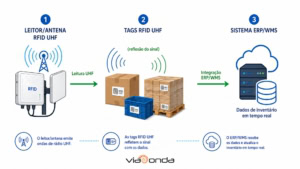
The Communication Cycle
The process begins when the RFID reader It sends a radio signal through its antennas, creating an electromagnetic field in the coverage area.
When a Passive Tag When it enters this field, it captures a fraction of that energy through its own internal antenna to power the chip.
Once powered on, the chip modulates the signal and “reflects” it back to the RFID reader, transmitting its data. Unique ID (EPC – Electronic Product Code) and other recorded data.
This entire process takes place in milliseconds, allowing hundreds of labels to be read almost instantly.
Passive vs. Active Tags
A Viaonda focuses primarily on systems of Passive Tags, which do not have an internal battery.
The advantages are clear:
- Low Unit Cost: It allows for large-scale item labeling.
- Longevity: With no batteries to run out, the tag can last for decades.
- Sustainability: Lower environmental impact from disposal. On the other hand, the Active Tags They have their own power source, reaching greater distances, but with significantly higher costs and maintenance, being reserved for very specific niches of monitoring extremely high-value assets.
The Role of Antennas and the Electromagnetic Field
The efficiency of an RFID project lies in Antenna Engineering.
The choice between antennas polarization linear (greater range in a specific direction) or circular (best for reading tags in varying orientations) defines reading success.
The signal power density follows the logic of the free-space propagation equation, where the power received by the tag decreases with the square of the distance:

Where d is the distance and the Greek letter Lambda represents the wavelength.
A Viaonda It calibrates these parameters to ensure that the electromagnetic field covers exactly the desired zone, avoiding unwanted readings from neighboring items.
Technical Superiority: The Physics Behind the UHF RFID Reader
Unlike low-frequency or high-frequency (LF/HF) technologies, the Reader UHF RFID operates in the range of 860MHz to 960MHz (in Brazil, regulated by ANATEL between 902-907,5 MHz and 915-928 MHz).
This frequency band is the global standard for logistics and manufacturing due to its propagation capability and high data transfer rate.
The engineering applied by Viaonda It explores electromagnetic properties to enable... mass reading.
While a barcode operator needs to "aim" at each label, Viaonda's UHF system captures data from entire pallets in motion.
Gateway and RTLS Infrastructure
Effective implementation requires more than just readers; it requires the design of Smart gateways Strategically positioned at docks and transition points.
These portals create automated reading zones that record movements in milliseconds.
When integrated into systems of RTLS (Real-Time Location System)The technology enables asset triangulation, providing the exact location of tools, molds, or finished products within complex industrial plants, using algorithms. RSSI (Received Signal Strength Indicator) to estimate proximity.
Technical Decision Matrix
For IT managers and logistics directors, the choice of data capture technology should be guided by scalability and performance criteria.
The table below details the superiority of UHF in high-volume environments:
Criterion
- Reading Range
- Capture Speed
- Line of Sight
- Tag Cost
- Mass Reading
- Ideal Application
Barcode
- Short (Visual)
- 1 item at a time
- Mandatory
- Minimum (Print)
- Impossible
- B2C Retail
RFID HF (13,56 MHz)
- up to 10cm
- Low (sequential)
- Not necessary
- Medium / High
- Limited
- Payments / Access
RFID UHF (Viaonda)
- Up to 12+ meters
- >500 items / second
- Not necessary
- Low (Passive Tags)
- Excellent
- Logistics / Industry
Detailed Applications by Sector
The versatility of UHF RFID allows that Viaonda It operates on several fronts, each with its own technical particularities:
Industry: WIP Traceability and Asset Management
In manufacturing, the control of WIP (Work In Progress) is vital.
Robust tags accompany the product from raw material to final assembly, recording each step of the process without human intervention.
Furthermore, the control of tools and molds High-value maintenance ensures that no items are improperly removed from the plant and that the preventive maintenance schedule is strictly followed based on actual usage.
Logistics: Efficiency in Material Handling
The use of RFID Portals in docks revolutionizes the cross docking.
The inbound and outbound pallet verification process is automated, eliminating truck queues and shipping errors.
Integration with routing systems allows the system to validate whether the correct item is being loaded onto the correct vehicle, issuing real-time alerts in case of discrepancies.
Retail: The Heart of Omnichannel
For modern retail, inventory needs to be unified.
RFID enables daily inventory counts with precision. 99 %, essential for strategies of Ship-from-Store (send from the store).
In addition, it operates in loss prevention, identifying exactly which item was stolen, and improving the customer experience through smart fitting rooms and ultra-fast checkout.
Access Control: Vehicles and Restricted Areas
Vehicle identification in condominiums, logistics fleets, or toll booths utilizes UHF technology to allow for smooth passage.
In restricted areas, UHF RFID badges They allow for monitoring the flow of people in large industrial plants, ensuring safety in case of emergency evacuation.
Return on Investment (ROI) and Financial Impact
Investing in solutions from Viaonda RFID This is justified by direct and indirect operational gains that impact the EBIT Organization.
The typical payback period for our projects occurs between 12 and 18 monthsdepending on the complexity and volume of assets.
- 30% Reduction in Inventory Time: What used to take days and required a complete shutdown of operations is now done in hours with portable RFID reader collectors, keeping operations running smoothly.
- 20% Reduction in Inventory Losses: Full visibility prevents theft and avoids products from expiring or being forgotten at the back of the warehouse.
- Workforce Optimization: Automating conference calls frees up teams for analytical activities. In a real-world case, a distribution center would reduce its processing time by... 85 % The loading and unloading verification time after the implementation of Viaonda's RFID Portals.
- Data Accuracy: Eliminating human error raises inventory accuracy to levels close to 99,9 %allowing for a drastic reduction in safety stock and freeing up working capital.
Why Choose Viaonda RFID?
UHF RFID reader technology is not an off-the-shelf solution; its efficiency depends on a specialized radio frequency engineering.
A Viaonda RFID It stands out in the Brazilian market by offering:
- Dedicated RF Engineering: We carried out a Site Survey exhaustive process to map interferences and define the ideal hardware for each environment.
- Native Integration: Our solutions are designed to "talk" to your legacy systems (SAP, Oracle, TOTVS, Senior(among other things), ensuring that the data captured on the factory floor reaches the company's board with integrity.
- Technical support: We understand the urgency faced by Brazilian industry. Our support is agile and focused on the continuity of your business.
- Customized Projects: We don't believe in "one size fits all." Viaonda, together with its partners, offers solutions ranging from special tags for high-temperature environments to tailored middleware software for complex business rules.
Viaonda Engineering as a Strategic Differentiator
Adopting the UHF RFID reader is a game-changer for companies seeking maturity in the market. Industry 4.0.
More than just a simple label, it's about creating a digital nervous system for its operation.
Real-time visibility, elimination of phantom inventory, and process automation are the pillars that underpin competitiveness in the globalized market.
A Viaonda RFID And its integrators position itself as the strategic partner for companies seeking not just hardware, but a complete engineering project — from concept to execution and maintenance.
By adopting the UHF standard, your organization takes the definitive step towards operational efficiency, transforming logistics into a data-driven, agile, and error-free operation.